
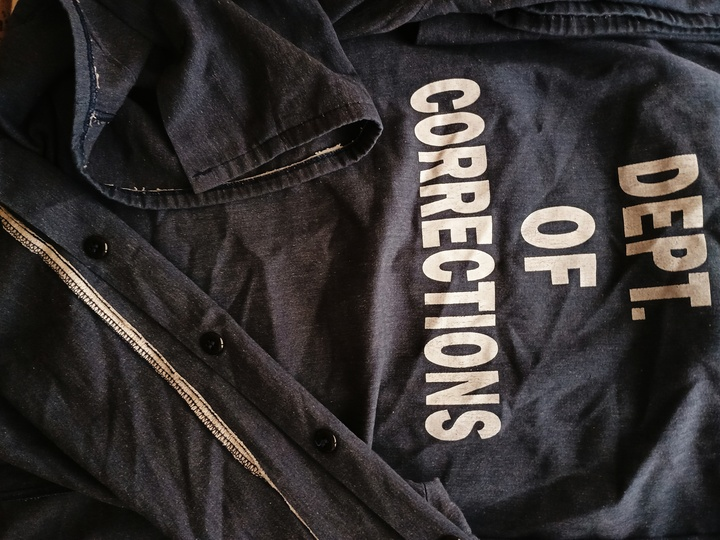
After issuing prisoners the same lined winter jackets since 1991, last winter the Georgia Department of Corrections (GDC) sent them back to us with the liners missing. GDC had started to replace them with a single-layer version that has no liner, and ordered warehouse workers to cut the liners off of the old ones so as to keep them all the same. We hoped the change wasn’t permanent, but this year’s jackets are linerless and that is the way we expected them.
Lined jackets weren’t the first things to go. We used to be able to keep the jackets year-round, until 2011 when a memo informed us that from then on we’d only have them from October to March. This change was also applied to having a second blanket. Around the same time, GDC stopped issuing long-sleeved shirts.
But the real harbinger was the brogan boots, in 2017. Prisoners here had been wearing brogans for as long as anyone could remember; they were the first piece of property you were issued when you arrived. They also flopped around and raised blisters no matter how you tied them. One day staff came around with boxes of orange Crocs and told everyone without a job—which was most of us by then—to hand over their brogans. The Crocs are currently black rather than orange, but no more suited to cold weather.
Since 2017, GDC has also taken away thermal underwear, knit skull caps and raincoats. If you want the first two you now have to buy them from commissary, which the majority of people here cannot afford to do. Raincoats aren’t sold at commissary. You can file a grievance to get one, and maybe get transferred in retaliation and have to leave it behind anyway.
We can have sneakers if someone on our visitor list orders the ones sold by the private vendors that do our property packages, but the only shoes we’re allowed to wear outside are state-issue. So these days our winter shoes are Crocs, our winter jackets are basically thick long-sleeved shirts and any other warm clothing is out of reach for all but a few who can buy it if they forgo buying some food.
The prisoners who still have brogans, along with lined jackets and all the rest, are the ones assigned to an outside work detail. But those don’t really exist anymore at the prisons where the security level is medium or higher.
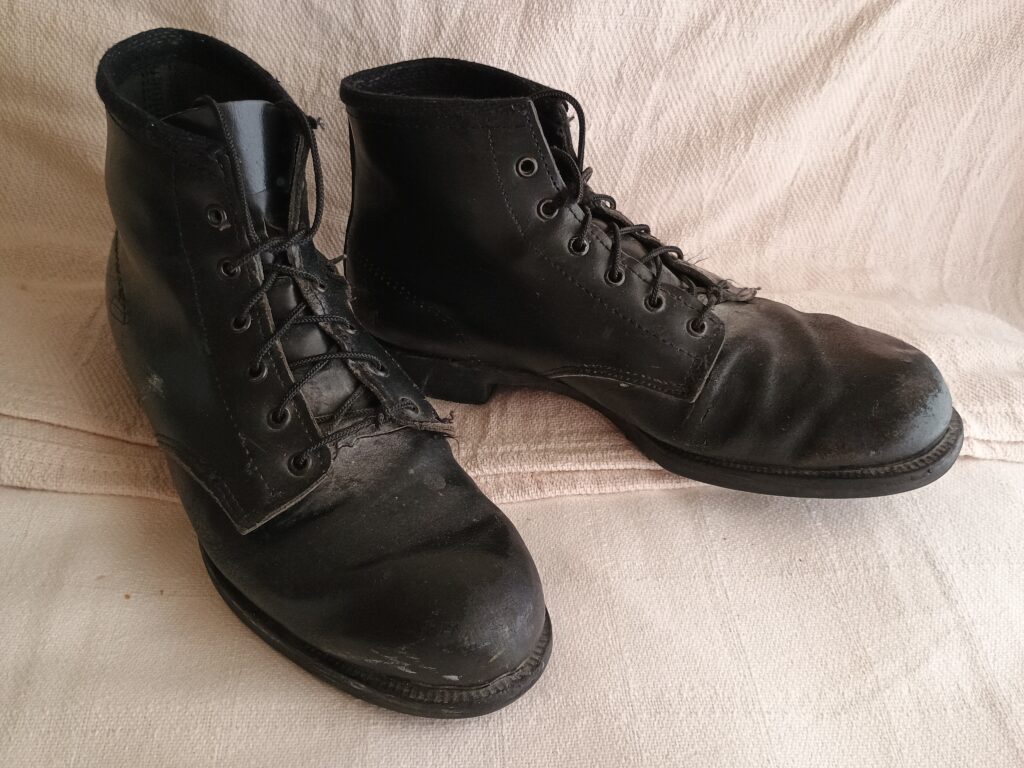

Outside detail is the continuation of the “chain gang” system that Georgia operated until 1943, just without the chains now. These are the road crews you might see digging ditches, doing storm cleanup or operating machinery at landfills. It’s hard labor under the hot sun, or in the rain, and it’s the reason the GDC wanted us to have boots.
In the early 1990s, outside crews cut highway grass with swingblades. We cleared brush with bushaxes. We broke up dirt with pickaxes and then carried it away in five-gallon buckets, because wheelbarrows were soft on crime. The easiest days were the ones when we just spent eight hours stooped over picking up litter by hand, because there was always the hope of finding cash or cigarettes. An officer would stand over us with a shotgun.
The traditional road crew was 10 minimum-security prisoners and one Trusty, the unofficial security level lower than minimum. It’s reserved for prisoners deemed trustworthy enough for staff to delegate some authority—such as carrying the officer’s shotgun. Back when I began my sentence, a Trusty could even get a furlough to spend the holidays with family.
Lifers used to be able to make Trusty after they’d served at least 16 years. But in the late 2000s, all lifers who’d made minimum-security, myself included, were suddenly knocked back to medium. GDC decided that lifers were no longer eligible to go to minimum, regardless of their conduct. And that only minimum-security prisoners were eligible for outside work detail. Fast-forward to present day, and this has effectively made most of the older prisoners ineligible for winter clothes.
As of November 1, minimum-security prisoners make up less than 15 percent of the GDC population. The people considered worthy of outside detail, and winter clothing, are pretty much just the ones passing through on a DUI or back for a short stint due to parole revocation.
Long State Prison, a medium-security annex of the higher-security Smith State Prison, lists well over a dozen outside details and is the best remaining example of what used to be the norm. But it’s also where GDC houses the wealthy and privileged. Those outside details are likely to have them sweeping floors or vacuuming carpets, or washing government cars in a covered bay.
The state’s interest in keeping people incarcerated isn’t really about slave labor anymore, or at least not predominately. Prisons are filling up with old men in poor health whose sentences get longer and longer, but that’s fine if the point is just to have enough bodies to justify building new high-security prisons where we’re all locked in cells 23 hours a day. Why waste money on warmer clothes if we don’t need to be healthy, and if eventually we won’t be going outside anymore anyway?
It should be noted that one problem shared by prisoners across the country is that while the walls in a living unit might be sturdy, they’re not insulated. Minus the effects of wind and rain, the temperature inside stays pretty close to the temperature outside.
Images via Anonymous
link