
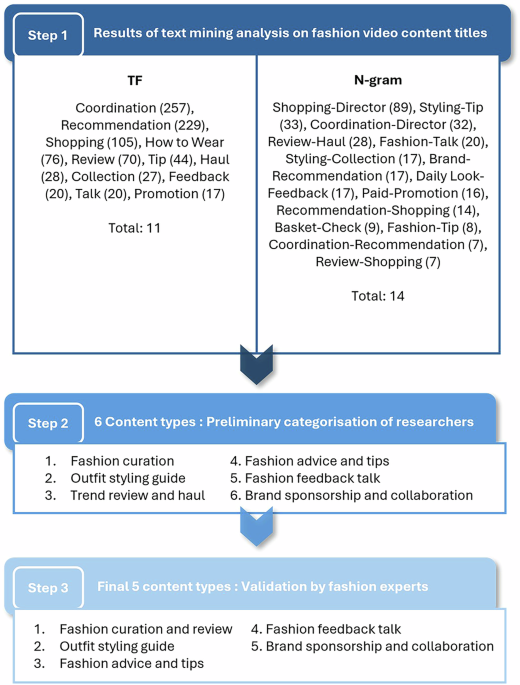
Identification of key types of men’s fashion on YouTube
The key types of YouTube content on Korean men’s fashion were categorised into five groups: fashion curation and review, outfit styling guide, fashion advice and tips, fashion feedback talk, and brand sponsorship and collaboration. The fashion curation and review type consists of content regarding YouTubers’ recommendations for, or introduction of, fashion items and their reviews based on their personal experiences with products. This type of content is characterised by product recommendations and guidance tailored for beginners who are developing an interest in fashion. The second group—outfit styling guide—focuses on providing guidance on men’s fashion styles and coordination methods. This content is typically presented in a lookbook format, in which YouTubers showcase various outfits by trying them on themselves. A key feature of this type is the suggestion for styling tailored to specific TPO (Time, Place, Occasion) contexts. The third group—fashion advice and tips—includes content that provides various fashion-related information and tips, such as those on styling, clothing care, and storage. A distinctive feature of this type is that it provides detailed guidance on highlighting one’s physical strengths and addressing weaknesses when wearing clothes. The fourth group—fashion feedback talk—involves inviting female guests to provide feedback on men’s fashion styles from women’s perspectives, while the YouTuber tries various outfits in a talk show format. A distinctive feature of this type is that it also includes content in which YouTubers review photos of subscribers’ everyday outfits and provide constructive feedback for improvement. The fifth type—brand sponsorship and collaboration—involves receiving direct sponsorships from brands to introduce products and encourage sales. This format often includes detailed product introductions along with information on discounts and discount links provided in the video description, making it easier for subscribers to purchase items. A notable feature of this type is the inclusion of content in which YouTubers collaborate directly with brands to create and sell their products.
Analysis of features in YouTube content
Fashion curation and review
In this type, the words ‘Shoes’, ‘Purchase’, ‘Colour’, ‘Brand’, and ‘Recommendation’ appeared with high frequency (see Table A2 in the Appendix). Additionally, given the nature of videos related to recommendations and reviews on fashion, the words ‘Purchase’, ‘Recommendation’, ‘Item’, ‘Product’, and ‘Introduction’ frequently co-occurred. Notably, among fashion items, ‘Shoes’ emerged with the highest TF and TF-IDF values. ‘Brand’ related terms such as ‘Nike’, ‘Converse’, ‘Vans’, and ‘New Balance’, associated with ‘Shoes’, were also identified. These primarily represent sporty and casual footwear brands, and categories such as ‘Trainers’, ‘Derby Shoes’, and ‘Runner’ also appear, demonstrating connections to specific brands. The reason why ‘Shoes’ ranked first and related words were also identified is that in men’s fashion, the word ‘Shoes’ is considered the most accessible item to match various styles. ‘Colour’ also exhibited high TF-IDF values, with ‘Black’, ‘White’, and ‘Grey’ ranking prominently, indicating a frequent recommendation of basic colours. Another notable item was ‘T-Shirt’, which showed relatively high TF-IDF values. Related to this, essential items for styling, such as ‘Short Sleeve T-Shirt’ and ‘White T-Shirt’, were also introduced. Additionally, basic style items like ‘Jacket’, ‘Trousers’, ‘Hoodie‘, ‘Jeans‘, and ‘Cardigan’ also appeared frequently. Additionally, words such as ‘First’ and ‘Preparation’ appeared, highlighting content aimed at men who were new to fashion. This indicates that the aforementioned fashion brands and items serve as accessible starting guides for beginners. Both ‘Street’ and ‘Classic’ styles were identified, along with the introduction of trendy fashion styles, such as ‘Gorpcore Look’ and ‘Windbreaker’. The results of 40 words extracted based on the TF values are visualised as a word cloud in Fig. 3a.

This figure presents the visualisation results for the fashion curation and review type, including (a) a word cloud, b a network visualisation, c an ego network-form visualisation based on N-gram values for ‘shoes’, and (d) an ego network-form visualisation based on N-gram values for ‘recommendation’.
Figure 3b illustrates interconnections between 40 words. A strong connection was observed between ‘Brand’-‘Short Sleeve T-Shirt’, and between ‘Brand’-‘Size’, ‘Brand’-‘Purchase’, ‘Purchase’-‘T-Shirt’, and ‘T-Shirt’-‘White T-Shirt’. This suggests that when purchasing basic short-sleeved or white T-shirts, brand recommendations, size suggestions, and reviews are prominently mentioned. Connections were also observed between ‘Colour’-‘Product’, and ‘Colour’-‘Grey’. Additionally, a relationship between ‘Brand’-‘Cap’-‘Large Head’ was identified. This reflects content-introducing brands and products that address the need for caps suitable for East Asian men, particularly to complement larger head size, which is a common physical characteristic.
Next, the words ‘Shoes’, which had the highest TF-IDF value, and ‘Recommendation’, which showed significant values in N-gram and degree centrality, were set as ego nodes to examine which words were connected as alter nodes. First, as shown in Fig. 3c, ‘Shoes’ was frequently connected to words such as ‘Style’, ‘Recommendation’, and ‘Utilisation’. Many recommendations for shoes in everyday wearable colours appeared, including ‘Daily’, ‘Basic’, ‘All Black’, ‘White’, ‘Triple Black’, and ‘All White’. Words such as ‘Priority’, ‘Purchase’, ‘New Balance’, and ‘Vans’ were also linked. Additionally, ‘Tight Lacing’ and ‘String’ appeared, offering specific guidance on how shoelaces can be tied and tightened.
As shown in Fig. 3d, the word ‘Recommendation’ frequently co-occurs with words such as ‘Brand’, ‘Shoes’, ‘Trainers’, and ‘ShortSleeveTShirt’. The content under ‘Recommendation’ significantly emphasises shoes and T-shirts, introducing items that are prioritised for beginners in fashion, such as ‘First Priority’, ‘Inexpensive’, ‘Product’, and ‘Item’, recommending easily accessible and affordable products. Words like ‘Jacket’, ‘Minimal’, and ‘Casual’ were also linked, along with recommendations for ‘Elevator’ shoes to complement shorter heights and suggestions related to ‘Size’, which are notable features.
Outfit styling guide
In this type, words ‘Coordination’, ‘Match’, and ‘Styling’ appeared with high frequency (see Table A3 in the Appendix). In TF-IDF analysis, ‘Coordination’ recorded the highest value. YouTubers showcase various ‘Look’ options by wearing them directly and creating video ‘Lookbook’ for their subscribers. The content primarily focuses on how to coordinate ‘Utilisation’ with ‘Layered’ items such as ‘T-Shirt’, ‘Knit’, ‘Trousers’, ‘Shoes’, ‘Shirt’, ‘Suit’, ‘Hoodie’, and ‘Sneakers’, with ‘T-Shirt’ showing a relatively high TF-IDF value among the items. Specific styles such as ‘Casual’, ‘Effortlessly Chic‘, and ‘Street’ were identified, with ‘Effortlessly Chic’ notably having a relatively high TF-IDF value. Consequently, words like ‘Neat’, ‘Basic’, and ‘Simple’ also appeared. Although the word ‘Suit’, traditionally considered a staple of men’s basic style, was identified, it ranked lower, indicating a current preference for more casual styles in men’s fashion. ‘Colour’ also emerged as an important styling element, with words representing basic colours such as ‘Black’, ‘White’, ‘Beige’, ‘Ivory’, and ‘Khaki’. Notably, the words ‘Bright’ and ‘Tone on Tone’ suggest a preference for a soft look that is neither too dark nor overly contrasting in colour matching. Additionally, terms related to styling guides based on TPO were identified. Words like ‘Blind Date’, ‘Wedding Venue’, and ‘Date Look’ highlight content that provides guidance on how individuals can style themselves for occasions involving romantic encounters. A feature of this type appears in the ‘20s’ and ‘30s’, indicating the target age range of men for whom styling suggestions are primarily made. Figure 4a shows the words extracted as word clouds.

This figure presents the visualisation results for the outfit styling guide type, including (a) a word cloud, b a network visualisation, c an ego network-form visualisation based on N-gram values for ‘coordination’, and (d) an ego network-form visualisation based on N-gram values for ‘effortlessly chic’.
Examining relationships between words in Fig. 4b, the connection between ‘Coordination’ and ‘Match’ showed the greatest strength. Significant connections were also identified between ‘Match’-’Look’, ‘Coordination’-’Utilisation’, ‘Coordination’-‘Key Elements of Dressing’, and ‘Coordination’-‘Colour’. This suggests that, in outfit styling coordination, various items are utilised and matched to create a complete look, with colour serving as a critical element. Connections observed between ‘Coordination’-‘Effortlessly Chic’, ‘Coordination’-‘Basic’, and ‘Coordination’-‘Casual’ provide insights into the fashion style moods to which Korean men aspire.
Next, we selected ‘Coordination’, which recorded the highest TF-IDF value among 40 words, and ‘Effortlessly Chic’, which had the highest TF-IDF value among words describing styles, as ego nodes. Examining the co-occurring words centred around ‘Coordination’ in Fig. 4c, ‘Utilisation’, ‘Recommendation’, ‘Completion’, and ‘Match’ appeared with high frequency. Additionally, words such as ‘Casual’, ‘Basic’, ‘Simple’, ‘Dandy’, ‘Neat’, ‘Formal’, and ‘Classic’ were also present, along with ‘Suitable’, ‘Autumn’, ‘Holiday’, and ‘Date Look’, which refer to appropriate outfits for specific seasons and occasions. The word ‘Boyfriend Look’, which refers to fashion styles that girlfriends or romantic partners are likely to prefer for their boyfriends, also appeared in connection with ‘Coordination’.
In Fig. 4d, the word ‘Effortlessly Chic’ frequently co-occurs with ‘Look’ and ‘Casual’. Words such as ‘Mood’, ‘Lookbook’, and ‘Coordination’ were also used in connection. The ‘Effortlessly Chic’ style is represented by terms such as ‘Casual’, ‘Street’, ‘Dandy’, ‘Minimal’, ‘Simple’, and ‘Sexy’. Moreover, ‘Tone on Tone’ was identified as one way to express the ‘Effortlessly Chic’ style, and it was also found to be associated with ‘Boyfriend Look’ and ‘Campus Look’. The appearance of words, such as ‘Sense’ and ‘Suit’ and the inclusion of ‘Cost-Effectiveness’ indicates that price considerations are also factored into this style.
Fashion advice and tips
In this type, the words ‘Trousers’, ‘Tuck In’, ‘How to Wear’, ‘T-Shirt’, and ‘Shoes’ appeared with high frequency (see Table A4 in the Appendix). Notably, ‘Trousers’ recorded the highest value in TF, while ‘Tuck In’ showed the highest value in TF-IDF. Words related to height or length of legs, such as ‘Leg’, ‘Long’, ‘Height’, ‘Short’, and ‘Length’, as well as ‘Tip’ like ‘Roll-Up’ and ‘Cropped’, were identified. Therefore, words describing different ‘Fit’ styles, including ‘Slim’, ‘Wide’, ‘Straight’, ‘Wide Fit’, and ‘Slim Fit’, were also extracted, with ‘Wide’ showing a relatively high TF-IDF value. In explanations on complementing ‘Body Type’, words referring to body parts such as ‘Waist’, ‘Hips’, ‘Thigh’, ‘Shoulder’, ‘Pelvis’, ‘Waistline’, and ‘Calves’ appeared, with ‘Hips’ recording a relatively high TF-IDF value. Additionally, words like ‘Hanger’ and ‘Storage’, related to the methods of properly storing clothes, were noted, with ‘Hanger’ showing a relatively higher TF-IDF value than other words. Figure 5a shows the extracted words as word clouds.

This figure presents the visualisation results for the fashion advice and tips type, including (a) a word cloud, b a network visualisation, c an ego network-form visualisation based on N-gram values for ‘body type’, and (d) an ego network-form visualisation based on N-gram values for ‘tip’.
In the network visualisation results shown in Fig. 5b, connections between ‘Tuck In’-‘How to Wear’ and ‘Trousers’-‘Shoes’ exhibited very high strength. Connections such as ‘Trousers’-‘Waist’, ‘Trousers’-‘Leg’, and ‘Trousers’-‘T-Shirt’ were also observed. Similarly, significant connections appeared between ‘Tuck In’-‘Body Type’, ‘Tuck In’-‘Shirt’, and ‘Tuck In’-‘Waistline’. Notable linkages related to methods of wearing clothes included ‘How to Wear’-‘Shirt’ and ‘How to Wear’-‘T-Shirt’. Additionally, connections highlighting physical characteristics, such as ‘Long’-‘Leg’, ‘Height’-‘Short’, and ‘Short’-‘Leg’, were identified. A unique feature was the appearance of connections such as ‘Hang’-‘Hanger’ and ‘Hanger’-‘Shoulder’.
Next, based on the importance of providing complementary information to Korean men according to their body types, we selected ‘Body Type’ and ‘Tip’ as ego nodes, reflecting the opinions of the expert group. In Fig. 5c, centred around the word ‘Body Type’, the words ‘Complement’ and ‘Slim’ most frequently co-occurred. The word ‘Tuck In’ appeared among the top-ranking words, along with its opposite, ‘Untucked’. Around ‘Body Type’, connections were observed with ‘Slim Fit’, ‘Silhouette’, ‘Suits Well’, and ‘Well-Fitted’. A notable feature was the extraction of specific terms describing various body types of Korean men, such as ‘Wide Pelvis’, ‘Pot Belly’, ‘Muscular’, ‘Bottom Heavy’, ‘Upper Body Dominant’, ‘Inverted Triangle’, and ‘Chubby’. Therefore, connections related to lower-body items, such as ‘Trousers’ and ‘Jeans’, were identified in association with body types. As shown in Fig. 5d, with ‘Tip’ set as the ego node, the connected alter nodes revealed that ‘Shirt’ and ‘Preparation’ appeared with the highest frequency. Connections with ‘Laundry’ and ‘Summer’ were also observed. The appearance of the word ‘Short Guy’ suggests that fashion-related ‘Tip’ for shorter men were mentioned. Therefore, words such as ‘Length’, ‘Roll-Up’, ‘Bottoms’, ‘Ankle Length’, ‘Instep’, and ‘Long’ were connected.
Fashion feedback talk
In this type, ‘Mood’, ‘Good’, ‘Colour’, and ‘Coordination’ appeared with high frequency, with ‘Mood’ and ‘Good’ also recording high TF-IDF values (see Table A5 in the Appendix). A characteristic of this type is that words reflected emotions and thoughts, such as ‘Good’, ‘Fine’, ‘Like’, ‘Thought’, ‘Dislike’, ‘Liking’, and ‘Likes and Dislikes’. Because of the nature of the content, which involved evaluating men’s fashion styles from a female perspective or providing feedback on subscribers’ fashion styles, words such as, ‘Man’, ‘Woman’, ‘Score’, and ‘Subscriber’ were also identified. As ‘Mood’ was the most significant word, specific descriptors such as ‘Pretty’, ‘Neat’, ‘Cute’, ‘Excessive’, and ‘Attractive’ co-occurred. Within ‘Coordination’, the importance of ‘Colour’ was highlighted, with ‘White’ and ‘Black’ being notable. Among fashion items, ‘Shoes’ had the highest frequency, followed by ‘Jeans’, ‘Puffer Jacket’, ‘Trousers’, ‘Coat’, ‘Shirt’, ‘Bag’, ‘Sneakers’, ‘White T-Shirt’, and ‘Belt’. Additionally, words related to men’s physical characteristics, such as ‘Height’ and ‘Long’, were observed, with ‘Height’ showing a relatively high TF-IDF value. Finally, as the evaluation is based on personal thoughts and opinions, ‘Personal’ and ‘Preference’ were also identified. Figure 6a visualises the extracted words as a word cloud.

This figure presents the visualisation results for the fashion feedback talk type, including (a) a word cloud, b a network visualisation, c an ego network-form visualisation based on N-gram values for ‘mood’, and (d) an ego network-form visualisation based on N-gram values for ‘like’.
In the network visualisation shown in Fig. 6b, the connection strength between ‘Colour’-‘White’ was the highest. Strong connections were also observed between ‘Mood’-‘Colour’, ‘Mood’-‘Good’, ‘Colour’-‘Puffer Jacket’, and ‘Colour’-‘Black’. Connections among ‘Colour’, ‘Coordination’, and ‘Coat’ nodes were identified, as well as between ‘Colour’-‘Key Elements of Dressing’. Additionally, connections such as ‘Like’-‘Woman’, ‘Like’-‘Cute’, ‘Like’-‘Neat’, and ‘Like’-‘Man’ suggest a linkage to moods and styles preferred by women. Significant connections were also found among ‘Jeans’-‘White T-Shirt’, ‘Jeans’-‘Man’, ‘Jeans’-‘Woman’, ‘Man’-‘Shoes’, and ‘Man’-‘Puffer Jacket’.
In this type, the word ‘Mood’, which recorded the highest TF-IDF value, and ‘Like’, which showed high frequency in N-gram analysis, were selected as ego nodes. In Fig. 6c, centred around the word ‘Mood’, ‘Trend’, ‘Casual’, ‘Neat’, ‘Dandy’, ‘Dress Up’, ‘Elegant’, and ‘Street’ frequently co-occurred. This suggests a preference for trendy styles that maintain casual, clean, and polished fashion mood. Additionally, words such as ‘Sexy’, ‘Minimal’, ‘Cute’, ‘Feminine’, ‘Pretty’, ‘Sophisticated’, and ‘Excessive’ were also associated with ‘Mood’. Elements like ‘Colour’ and ‘Outerwear’ were found to influenced ‘Mood’, and the word ‘Boyfriend Look’, which reflected styles favoured by women, was a notable feature. Figure 6d examines the connected alter nodes centred around the word ‘Like’. The word ‘Woman’ appeared with the highest frequency. Next, the word ‘Neat’, which describes style moods, was prominent. In terms of items, ‘Shoes’, ‘Puffer Jacket’, ‘Sneakers’, ‘Spring Outerwear’, ‘Sweatshirt’, ‘Muffler’, ‘Jeans’, and ‘Short Sleeve T-Shirt’ were also identified. Regarding ‘Look’, ‘Blind Date Look’ and ‘Casual Look’ were commonly used, and terms such as ‘Bootcut’, ‘Wide Fit’, and ‘Slim Fit’ appeared as well. Overall, this analysis provides a detailed understanding of men’s fashion styles that women prefer.
Brand sponsorship and collaboration
‘Fabric’, ‘Colour’, and ‘Puffer Jacket’ had the highest TF and TF-IDF values (see Table A6 in the Appendix). Words related to ‘Fabric’, such as ‘Wool’ and ‘Warmth’, were extracted, indicating a focus on winter materials. Regarding ‘Colour’, words like ‘Black’, ‘White’, and ‘Grey’ appeared. In terms of ‘Item’, the identified words such as ‘Puffer Jacket’, ‘Coat’, ‘Jeans’, ‘Slacks’, ‘Trousers’, and ‘Shirt’ suggest that brand advertisements or collaborations were conducted for these items. As this content type involves recommending and introducing branded products or items to encourage purchases, words such as ‘Recommendation’, ‘Introduction’, ‘Brand’, and ‘Purchase’ were extracted. The extracted terms such as ‘Collaboration’, ‘Completion’, and ‘Production’ highlight collaboration with brands to produce products. Furthermore, as detailed pricing information is provided, words like ‘Price’, ‘Discount’, ‘Won’, and ‘Cost-Effectiveness’ were notable. Figure 7a visualises the extracted words as a word cloud.

This figure presents the visualisation results for the brand sponsorship and collaboration type, including (a) a word cloud, b a network visualisation, c an ego network-form visualisation based on N-gram values for ‘brand’, and (d) an ego network-form visualisation based on N-gram values for ‘price’.
As Fig. 7b shows, the connection strength between ‘Colour’-‘Black’ was the highest. Strong connections were also observed between ‘Colour’-‘Item’, ‘Item’-‘Recommendation’, ‘Fabric’-‘Recommendation’, and ‘Recommendation’-‘Wool’. Connections such as ‘Colour’-‘Grey’, ‘Colour’-‘Key Elements of Dressing’, ‘Colour’-‘Basic’, and ‘Colour’-‘Match’ were also prominent, highlighting key features emphasised in discussions on ‘Colour’. Connections like ‘Fabric’-‘Application’ and ‘Fabric’-‘Luxurious’ indicate greater importance of materials used in fashion items and high-quality materials. Additionally, connections such as ‘Introduction’-‘Brand’, ‘Puffer Jacket’-‘Introduction’, and ‘Item’-‘Attractive’ were also identified.
Next, based on the expert group’s evaluation, the emphasis on brand recommendations and pricing aspects were found to effectively represent the characteristics of this type. Consequently, ‘Brand’ and ‘Price’ were selected as ego nodes. In Fig. 7c, examining the alter nodes connected to the word ‘Brand’, ‘Introduction’ appeared with the highest frequency. This was followed by ‘Collaboration’, ‘Various’, and ‘Puffer Jacket’, which also showed high frequencies. Words directly referencing brand types or names, such as ‘SPA’, ‘Draw Fit’, and ‘Plac’, were used, along with item-related terms like ‘Puffer Jacket’, ‘Jeans’, ‘Coat’, and ‘Blazer’. Words addressing pricing aspects, such as ‘Expensive’ and ‘Cost-Effectiveness’, were also identified. Additionally, words such as ‘Fabric’, ‘Identity’, ‘Satisfaction’, and ‘Quality’ indicate the focus on material and product attributes. A notable feature was the word ‘Link’, which reflected the practice of providing URLs in the video description to allow subscribers easy access to purchase the featured brand products.
Figure 7d sets ‘Price’ as the ego node. The appearance of the word ‘Good’ with the highest frequency indicates that price was highly prioritised when purchasing fashion products. The Identified Words such as ‘High’, ‘Discount’, ‘Adjust’, ‘Inexpensive’, ‘Reasonable’, ‘Expensive’, ‘Comparison’, and ‘Cost-Effectiveness’ reflect criteria and various efforts aimed at achieving rational consumption.
Characteristics of Korean men’s fashion content on YouTube
Group 1. Casual and street trends in men’s fashion
Key words included in Group 1 of Fig. 8 are ‘Colour’, ‘Coordination’, ‘Match’, ‘Styling’, ‘Utilisation’, ‘Basic’, ‘Casual’, ‘Street’, ‘Dandy’, ‘Minimal’, ‘Effortlessly Chic’, ‘Boyfriend Look’, ‘Blind Date’, ‘Neat’, ‘20s’, ‘30s’, ‘Trousers’, ‘Jeans’, ‘Coat’, ‘Shirt’, and ‘Shoes’, and so on. Based on this, the group was named ‘casual and street trends in men’s fashion’. Men’s fashion is continuously evolving in Korea. Interest in age-appropriate styles is increasing across all age groups, from teenagers to men in their 20s, 30s, and 40s. Simultaneously, preference for YouTube content as a source of information on fashion has also increased. YouTubers often act as models themselves, showcasing styles that fit specific seasons, TPO, and age groups while presenting complete looks. The key point is that, rather than focusing on full setups, appropriate matching and coordination of individual items, such as trousers, shirts, coats, knits, cardigans, and hoodies are emphasised.
Styling a hoodie! Let’s wear it with personality!… The hoodie is an essential item for all occasions—whether in daily life, casual outings, or exam periods. In this video, we’ll share how to make the most out of a hoodie and how to add key styling points. We hope you enjoy watching! (Piro, 2020)

Visualisation of CONCOR analysis.
Traditionally, suits represented men’s fashion. However, they now evolve towards a more casual and street-inspired aesthetic. Commenting on this trend while suggesting wedding guest outfits, YouTuber Fit The Size (2020a), stated, ‘These days, the fully formalised, standardised suit style is no longer a trend.’ This reflects a shift in modern men’s fashion from conventional and standardised style codes, towards flexibility and creativity.
Today, there is a growing focus on skilfully mixing and matching individual items to create unique personal styles. Thus, styles such as ‘Casual’, ‘Street’, ‘Dandy’, ‘Minimal’, and ‘Effortlessly Chic’, which utilise basic items to achieve a neat aesthetic, have become increasingly popular. This trend reflects the values of modern Korean men, who aim to balance practicality with a sophisticated appearance. Additionally, styles like ‘Boyfriend Look’ and ‘Blind Date’, which emphasise outfits designed to appeal to women, have also gained prominence. This shift highlights the evolution of Korean men’s fashion towards an emphasis on natural, comfortable, and polished looks, free from strict formalities.
I’ve always prepared lookbooks tailored to TPO. Recently, I’ve covered various styles, including minimal, street, and casual. Today, I prepared a stylish and effortlessly chic lookbook that you can enjoy comfortably during vacation. (Kkang Stylist, 2020)
Group 2. Guidance for fashion beginners and the significance of female perspectives
In Group 2, words such as ‘Fabric’, ‘Puffer Jacket’, ‘Recommendation’, ‘Item’, ‘Style’, ‘Purchase’, ‘Trend’, ‘Attractive’, ‘Collaboration’, ‘First’, ‘Classic’, ‘Product’, ‘Black’, ‘Grey’, ‘Blazer’, ‘Nike’, ‘Converse’, ’Man’, ‘Woman’, ‘Like’, and ‘Cute’, were clustered together, leading to the designation of this group under ‘guidance for fashion beginners and the significance of female perspectives’. This reflects the continuous growth of Korean men’s interest in fashion alongside the rising popularity of video content tailored to fashion beginners. YouTubers introduce various products and offer comprehensive guidelines for male beginners. They recommend items and styles aligned with current trends, explain specifics, such as materials and colours, and justify why certain products should be prioritised for purchase. To engage fashion-inexperienced men, YouTuber Joo Woojae attempted to explain product prioritisation by drawing analogies with gaming terms familiar to male audiences. As these videos are aimed at beginners, they frequently highlight classic and essential items, specifically recommending shoes as a starting point.
The shoes I’m recommending today are not for those who already own and enjoy a vast collection of shoes but rather for those who are still unsure about what to buy. These shoes help establish a foundation for you. Once again, I’ll introduce shoes aligned with the LoL (League of Legends) line concept. (Today’s Joo Woojae, 2022)
Must-have items?… Since we can’t buy every piece of clothing, we need to set priorities when making purchases. In my opinion, shoes are the top priority. Shoes are something you wear daily, yet they don’t easily become boring and they can adapt to different styles, making them a crucial element. I believe shoes should come first because of their significance in both aesthetics and practicality. (Kkang Stylist, 2021)
This type of content helps men who are not yet familiar with fashion build a solid foundation in the basics of style while offering opportunities to develop a unique fashion identity.
The most essential aspect of recommending fashion items and styles is creating men’s fashion that appeals to women’s perspectives. This is particularly evident in the titles of fashion content videos, which often employ provocative and polarising phrases such as ‘Women love 00 vs. Women absolutely hate 00.’ These titles frame fashion as not only offering suggestions for personal style but also enabling one to appear attractive to the opposite sex, thus shaping men’s perception and approach towards fashion. Particularly noteworthy are videos in which female guests are invited, and the YouTuber personally tries various styles, receiving scores and feedback on their preferences. This content vividly illustrates how Korean men strive to gain romantic appeal through fashion. This shift signifies a departure from the traditional dynamics in which men judge women’s appearances and highlights a new perspective in which women evaluate men’s styles and appearances.
Finally, recommendations for collaborative products created by YouTubers and their brands are featured. These items, made from high-quality basic materials, were designed to be easy for beginners to incorporate into their daily wardrobes, encouraging male subscribers to purchase them. However, even when recommending items or developing collaborative products, a critical focus remains on men’s fashion as viewed from a female perspective. Ultimately, these fashion content and collaborations not only drive male consumer behaviour but also emphasise styles that appeal to women.
… I frequently produce boyfriendlook content with female guests, and one thing I’ve noticed is that women place more importance on trousers’ fit than you might think. So today, I’ll be diving into creating the ultimate boyfriendlook essential slacks. Let’s head up and discuss this in detail!… (Kkang Stylist, 2022a)
Group 3. Complement to body image
In Group 3, words such as ‘Body Type’, ‘Complement’, ‘Tuck In’, ‘Fit’, ‘Length’, ‘Leg’, ‘Height’, ‘Long’, ‘Tip’, ‘Roll-Up’, ‘Cropped’, ‘Slim’, ‘Straight’, ‘Oversized Fit’, and ‘Wide Fit’ were clustered together, leading us to label this group as ‘complement to body image’. This category offers various ways of enhancing and adapting styles to suit Korean men’s unique body types. YouTubers, Kkang Stylist (171 cm), Short-height Kwangja (169 cm), and FashionTube SakHyung (166 cm) openly embrace their shorter heights rather than hiding them, confidently delivering the message that ‘You can look stylish even if you’re short’ (FashionTube SakHyung, 2020). This approach fosters a sense of relatability, camaraderie, and trust among their viewers.
I’m 166 cm tall, which is on the shorter side, but I still manage to pull off wearing long coats, and this seems to surprise many people. I’ve noticed comments pointing this out quite often. So today, I’m going to share six tips for shorter men that can make them look at least 5 cm taller. If you want your legs to look longer, make sure you watch the video until the end! (FashionTube SakHyung, 2020)
Men’s attempt to appear taller manifests as actions aimed at overcoming their shortcomings through fashion styles. In video content, detailed styling tips, such as adjusting the proportion of the upper and lower body and making a short stature and legs appear longer through techniques like ‘Tuck In’, ‘Roll-Up’, ‘Cropped’, ‘Slim’, and ‘Straight’ are significantly emphasised. In this context, YouTubers with shorter appearance play a key role by personally wearing styling outfits that create an illusion of height and presenting them to their subscribers, effectively delivering a strong visual impact and serving as an important factor in building trust.
First, how does my trousers’ fit look on screen? I look taller than my actual height of 169 cm, don’t I? I’ll show you how to make your trousers’ fit look stylish while also making your legs appear longer. (Short-height Kwangja, 2020)
Additionally, as street and casual trends continue to dominate, creators are providing detailed guidance to their subscribers on how Korean men can wear comfortable styles like ‘Oversized Fit’ and ‘Wide Fit’ in ways that avoid making them look shorter and instead help them appear taller.
Many people think, ‘Will wide trousers not make my legs look shorter?’ when considering wearing them. If you wear it well, your legs will look longer and your proportions will look good… When wearing wide trousers, please wear them higher up in the waist and in a way that the waistline is slightly upwards. Just by raising the waistline, the proportions can look good and legs can look longer. (Kkang Stylist, 2023)
However, concerns about height among Korean men are not limited to appearance but extend to issues related to romantic relationships. YouTubers influence their subscribers’ minds by emphasising that appearing taller is a crucial aspect of attracting potential partners, often highlighting this point in their content. In Korean men’s fashion, the pursuit of an ideal body image and the appeal of romantic attractions remain central.
Worried about being short? Wondering if you can even date like this? Then hurry up and subscribe to my channel—let’s transform your style and boost your confidence in your appearance! (FashionTube SakHyung, 2020)
Thus, Korean men’s physical image is treated as an important topic in fashion. The content created by short-statured YouTubers, who actively address their shortcomings and propose styles that make them appear taller, provides realistic and practical information distinct from the idealised tall models showcased in traditional magazines or fashion collections. These YouTubers who have body types that are more commonly seen in everyday life and with whom the audience can relate not only serve as a valuable reference and guide for subscribers but also act as a source of motivation.
Group 4. Smart fashion choice balancing price and quality
In the fourth group, words such as ‘Brand’, ‘Introduction’, ‘Price’, ‘Cost-Effectiveness’, ‘Won’, ‘Discount’, ‘Luxurious’, ‘Wool’, ‘Quality’, ‘Warmth’, ‘Sheen’, and ‘Application’ were clustered. Male consumers did not primarily consider factors such as high prices and the recognition of luxury brands. YouTube content with high view counts does not always portray luxury goods positively. Instead, videos comparing luxury items with domestic brands to promote smart and practical consumption are common.
Today, I’ll talk about high-end and more affordable brands for recommending short-sleeve T-shirts all in one go… I don’t think I’d buy those clothes directly from a department store. It’s too expensive. I’d just try them on to check the size… buy them online at the lowest price. (Fit The Size, 2020b)
Price is crucial in Korean men’s fashion-consumption habits, and cost-effectiveness is considered a highly significant factor. This is particularly relevant, as many viewers of fashion content on YouTube are beginners in fashion or individuals in their 20s who often face financial constraints when purchasing high-priced items. However, this does not imply that they indiscriminately seek the cheapest option. YouTubers introduce fashion items that align with the price range that male consumers consider reasonable items that offer luxury quality while remaining relatively affordable. Particularly, in content sponsored by brands, official discounted prices are presented, allowing subscribers to watch the content and decide whether to make a purchase. Notably, videos related to high-priced winter outerwear and the Black Friday season tend to receive high view counts. This can be attributed to the efforts of subscribers who seek information to make rational purchases of expensive winter clothing.
And the price range is around 100,000 won, so the blazer I am introducing today is in the low-price range. I think it would be a great recommendation for those looking for cost-effective blazers. (Zzang9daddy, 2020)
In particular, when selecting and purchasing products, individuals’ expectations for fabric quality have emerged as a significant factor among the various design elements. In men’s fashion, where options for silhouettes, fits, and items are less diverse than in women’s fashion, fabric is a key element that can differentiate one product from another. Consequently, even within a limited budget, there is a notable tendency to prioritise luxurious, high-end fabric quality.
As I mentioned in the introduction to the puffer jacket trend, shearling wool fabric is widely used during this season. This fabric alone conveys the brand’s identity and showcases a luxurious take on puffer jackets. Just by incorporating this fabric, the puffer jacket exudes a genuinely luxurious and expensive look. (Kkang Stylist, 2022b)
Finally, YouTubers go beyond mere product promotions and take on the roles of shopping guides and consultants. They emphasise the importance of smart shopping—which is tailored to each individual’s circumstances, profession, and lifestyle, and deliver this message through their content.
… In fact, many people who don’t watch YouTube tend to follow trends simply because others wear certain brands or because their friends do so. However, when it comes to puffer jackets, it’s not about overextending oneself to keep up with others—it’s about purchasing based on one’s own circumstances and lifestyle. (Kkang Stylist, 2022b)
Therefore, in their fashion consumption habits Korean men emphasise cost-effectiveness while avoiding styles that appear cheap. They tend to prefer luxurious fabrics and upscaled images, reflecting the pursuit of smart consumption that balances rationality with sophistication. In this context, YouTube content goes beyond simple shopping recommendations, offering accurate product information and suggesting wise purchases tailored to subscribers’ lifestyles while presenting options within reasonable price ranges.
link