


North Delta Rotary program expanded to give kids in need winter clothes
Published 4:30 pm Wednesday, February 18, 2026
A Rotary-funded program to help cover back-to-school costs is also helping some local elementary students keep warm this winter.
Launched in 2024 in partnership with the Delta School District, the Rotary Club of North Delta’s Magic Pencil program helps local families who struggle to pay for their children’s back-to-school expenses by creating an annual fund for each elementary and secondary school so that teachers can purchase supplies on behalf of children who need them.
“It was so rewarding to hear so much gratitude from the school staff for this program. It takes so much pressure off [them],” Rotarian Shawn Gold, program organizer, said of that year’s Magic Pencil pilot.
District staff estimate that the annual cost of school supplies averages $100 for elementary students and $150 for youth in secondary school, noting each school and class has unique needs.
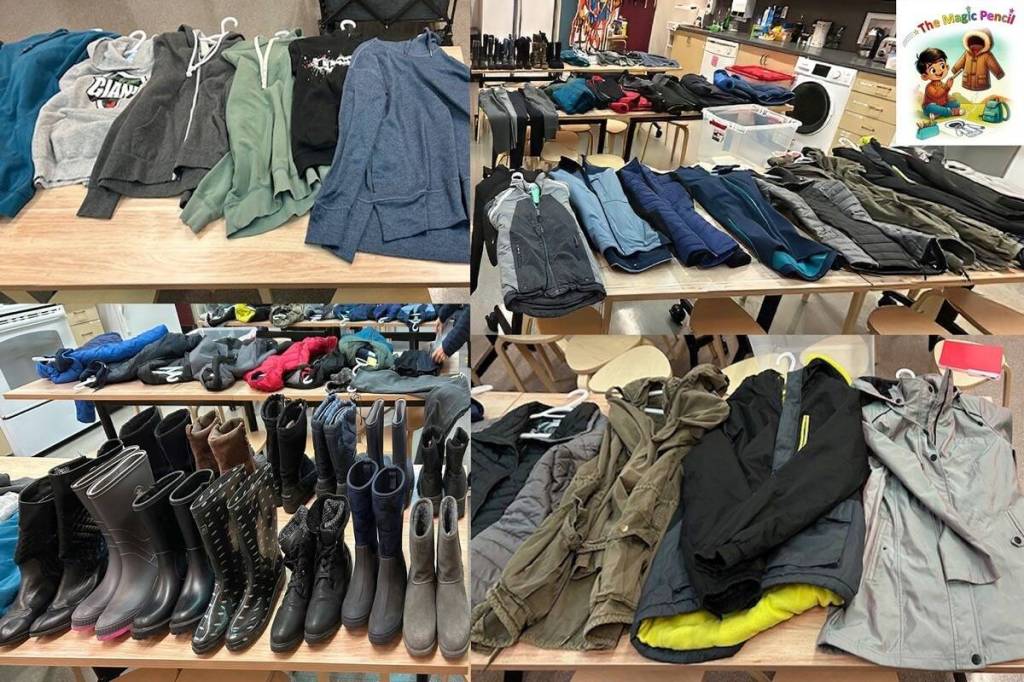
This year, thanks to local donors, those who supported the club’s summer/fall 50/50 raffle, and grants received from the Delta Community Foundation and the City of Delta, the North Delta Rotary has not only been able to help hundreds of children in need access the supplies they need, they’ve been able to expand the Magic Pencil program to include winter clothing.
To date, Rotary volunteers have contacted six North Delta elementary schools, asking for the clothing needs for ten children per school. Winter and wet-weather items including jackets, footwear, sweatpants and sweatshirts, in different sizes, was brought to each school, and children in groups of two or three quietly visited a classroom to pick out clothing and boots to bring home.
“We extend our sincere thanks to the North Delta Rotary Club, and its donors, for its Magic Pencil program. This initiative is making a meaningful difference in the lives of hundreds of students and their families,” Kirsten Hermanson, manager of prevention and school wellness with the Delta School District, said in a press release.
“By ensuring that Delta children have essential school supplies and warm winter clothing, Magic Pencil is helping to remove barriers to student learning and supporting their dignity, confidence and well-being.”
A press release announcing the program’s return for the 2025-2026 school year noted nearly 600 kids enrolled in North Delta’s 14 public elementary schools are food insecure, meaning their families likely also struggle to pay for the children’s school supplies and winter clothing.
According to the latest Early Development Instrument data — a survey used to gather information about five core “scales” of early childhood development (physical health and well-being, social competence, emotional maturity, language and cognitive development, and communication skills and general knowledge) in kindergarten students across B.C. — 28.4 per cent or 238 of children in Delta schools were found to be vulnerable in one or more area.
Broken down, the EDI data shows all three North Delta “neighbourhoods” (Sunshine Hills, comprised of most of the area south of 72nd Avenue; North Delta West, comprised roughly of everything north of 72nd, west of Highway 91 and east of 112th Street; and North Delta East, roughly everything east of 112th to Scott Road, plus a chunk extending south of 72nd to the Cougar Creek ravine, from 114A Street to Scott Road) had a higher incidence of vulnerability than the city average.
North Delta East in particular had a high level of vulnerability, with 95 (34.7 per cent) of children in the area at risk on at least one scale. The neighbourhood not only had the highest rate of vulnerability overall, it led all five Delta neighbourhoods in each of the five scales.
North Delta Rotary’s summer press release notes that studies in Canada, Australia and California have all concluded that children’s EDI scores strongly predicted their subsequent performance in language and mathematics classes in Grade 3.
link